Plot saccadic main sequence#
In this notebook we show how you can load a dataset, compute all the necessary properties and the plot the main sequence.
What you will learn in this tutorial:#
how to prepare your data to plot the saccadic main sequence
how to create a main sequence plot of your saccade events
Loading and preprocessing your data#
We import pymovements as the alias pm for convenience.
[1]:
import pymovements as pm
/home/docs/checkouts/readthedocs.org/user_builds/pymovements/envs/v0.14.0/lib/python3.9/site-packages/tqdm/auto.py:21: TqdmWarning: IProgress not found. Please update jupyter and ipywidgets. See https://ipywidgets.readthedocs.io/en/stable/user_install.html
  from .autonotebook import tqdm as notebook_tqdm
Let’s start by downloading our ToyDataset and loading in its data:
[2]:
dataset = pm.Dataset('ToyDataset', path='data/ToyDataset')
dataset.download()
dataset.load()
Using already downloaded and verified file: data/ToyDataset/downloads/pymovements-toy-dataset.zip
Extracting pymovements-toy-dataset.zip to data/ToyDataset/raw
100%|██████████| 20/20 [00:00<00:00, 201.13it/s]
[2]:
<pymovements.dataset.dataset.Dataset at 0x7f66a482b7f0>
Now, you have to convert the raw x and y coordinates in pixels to degrees in visual angle.
[3]:
dataset.pix2deg()
100%|██████████| 20/20 [00:00<00:00, 771.39it/s]
[3]:
<pymovements.dataset.dataset.Dataset at 0x7f66a482b7f0>
Next we can convert these positions into velocitites.
[4]:
dataset.pos2vel()
100%|██████████| 20/20 [00:00<00:00, 678.28it/s]
[4]:
<pymovements.dataset.dataset.Dataset at 0x7f66a482b7f0>
Let’s check if we now have all our expected columns:
[5]:
dataset.gaze[0].frame.head()
[5]:
| text_id | page_id | time | x_right_pix | y_right_pix | y_right_pos | x_right_pos | y_right_vel | x_right_vel |
|---|---|---|---|---|---|---|---|---|
| i64 | i64 | f64 | f64 | f64 | f64 | f64 | f64 | f64 |
| 0 | 1 | 1.988145e6 | 206.8 | 152.4 | -12.005591 | -7.528075 | -3.589697 | 1.221164 |
| 0 | 1 | 1.988146e6 | 206.9 | 152.1 | -12.01277 | -7.525633 | -7.179203 | 2.442343 |
| 0 | 1 | 1.988147e6 | 207.0 | 151.8 | -12.019949 | -7.52319 | -5.184827 | 1.628238 |
| 0 | 1 | 1.988148e6 | 207.1 | 151.7 | -12.022342 | -7.520748 | -4.386968 | 0.407059 |
| 0 | 1 | 1.988149e6 | 207.0 | 151.5 | -12.027128 | -7.52319 | -3.190445 | 0.407069 |
Detecting your events and compute properties#
In the next step we have to detect our saccades and compute the event properties amplitude and peak_velocity.
We can run the microsaccade detection algorithm with its default parameters:
[6]:
dataset.detect_events('microsaccades')
20it [00:00, 78.04it/s]
[6]:
<pymovements.dataset.dataset.Dataset at 0x7f66a482b7f0>
Next we compute the event properties ‘amplitude’ and ‘peak velocity’ for the detected saccades.
[7]:
dataset.compute_event_properties(['amplitude', 'peak_velocity'])
20it [00:22, 1.13s/it]
[7]:
<pymovements.dataset.dataset.Dataset at 0x7f66a482b7f0>
Let’s verify that we have detected some saccades and have the desired columns available.
[8]:
dataset.events[0].frame.head()
[8]:
| name | onset | offset | duration | text_id | page_id | amplitude | peak_velocity |
|---|---|---|---|---|---|---|---|
| str | i64 | i64 | i64 | i64 | i64 | f64 | f64 |
| "saccade" | 1988323 | 1988337 | 14 | 0 | 1 | 1.252096 | 131.445157 |
| "saccade" | 1988342 | 1988350 | 8 | 0 | 1 | 0.335018 | 51.184996 |
| "saccade" | 1988547 | 1988567 | 20 | 0 | 1 | 2.416716 | 202.367951 |
| "saccade" | 1988571 | 1988582 | 11 | 0 | 1 | 0.480982 | 56.535391 |
| "saccade" | 1988737 | 1988760 | 23 | 0 | 1 | 3.304035 | 250.889337 |
Plot the main sequence#
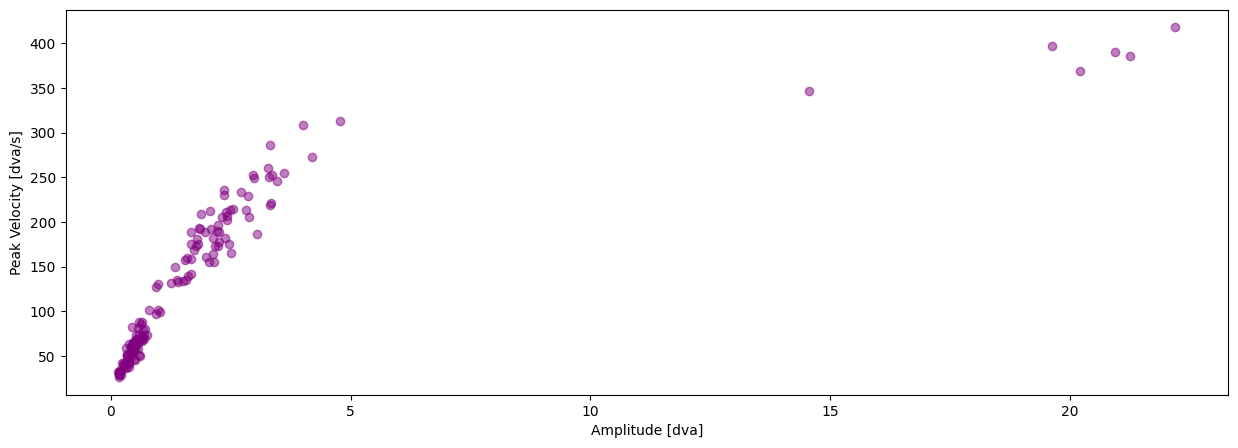
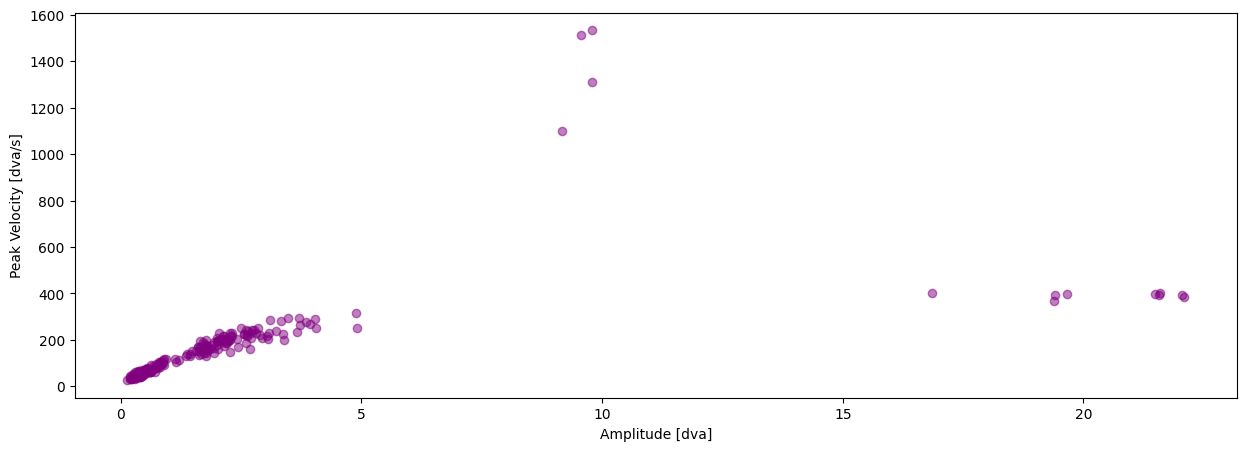
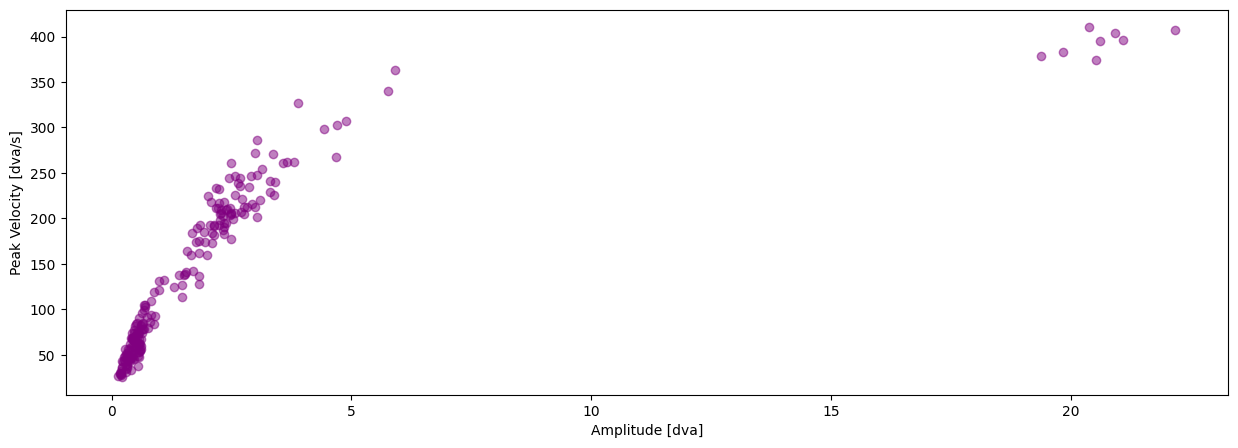
Now we just pass the event dataframe to the plotting function:
[9]:
# only showing the first three event dataframes here.
for event_df in dataset.events[:3]:
    print(
        f'Showing main sequence plot for '
        f'text {event_df[0, "text_id"]}, '
        f'page {event_df[0, "page_id"]}:')
    pm.plotting.main_sequence_plot(event_df)
Showing main sequence plot for text 0, page 1:
Showing main sequence plot for text 0, page 2:
Showing main sequence plot for text 0, page 3:
What you have learned in this tutorial:#
how to prepare your data to plot a main sequence
how to create a main sequence plot by using
main_sequence_plot